The Sacred Shade: Why Neem Trees Run Deep in Rajasthan's Soul (And Why We Named Ourselves After One)

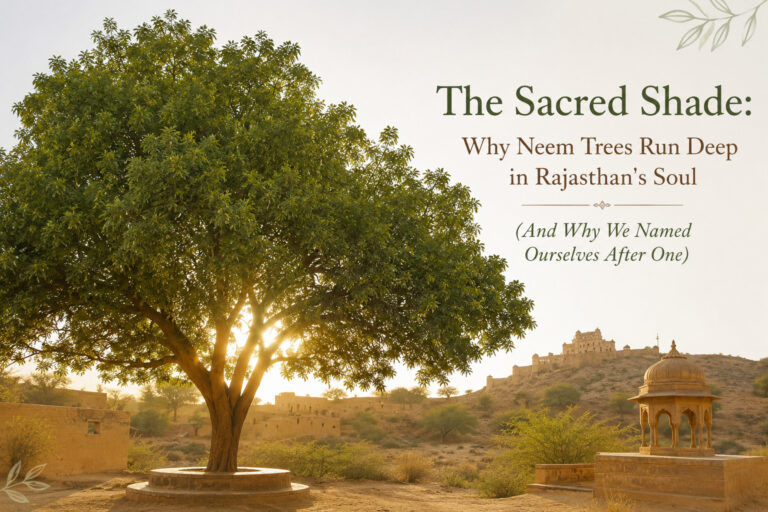
Drive through any village in Rajasthan, even in the driest stretches of the Aravallis, and you’ll notice something: somewhere near the well, the temple or the chaupal (village square), there’s almost always a neem tree standing guard. Not planted for ornament. Planted because for centuries, Rajasthani communities have understood something modern science only caught up to recently the neem tree is not just a tree. It’s medicine, shelter, ritual, and memory, all rooted in one place.
A Tree That Earned Its Place in the Desert
Rajasthan’s climate is unforgiving, scorching summers, scarce water, dust that doesn’t settle. Yet the neem thrives here, asking for little and giving back enormously. That resilience itself became part of its cultural meaning. In a land where survival required resourcefulness, a tree that purified the air, cooled the ground beneath it, and needed almost no irrigation was treated with something close to reverence.
Villagers traditionally built homes near neem trees deliberately, not by accident. The tree’s wide canopy drops the surrounding temperature noticeably, turning the ground beneath it into a natural meeting spot for panchayat discussions, for afternoon naps during the harshest hours, for children to play once the sun softened. The space under a neem tree became, in a very real sense, community infrastructure.
Healer of the Household
Long before “neem” became a buzzword on skincare packaging, Rajasthani households were using it as their first line of defense against illness. Neem leaves were boiled into water for fevers, crushed into pastes for skin ailments, and hung in doorways during outbreaks of chickenpox or measles, believed to purify the air and keep infection at bay. Neem twigs served as natural toothbrushes (datun) , a practice still alive in many rural homes today.
This wasn’t folk superstition disconnected from reality; it was generations of observed, practical knowledge passed down because it worked. The neem tree was, quite literally, the household pharmacy.
A Tree Woven Into Ritual and Belief
In Rajasthani tradition, the neem is closely associated with Goddess Sheetala, who is invoked for protection against disease, particularly during outbreaks. Neem leaves are offered at her shrines, and the tree itself is sometimes treated as a living extension of her protective presence. Weddings and other auspicious ceremonies in some communities incorporate neem leaves into rituals meant to ward off evil and bring purity to the occasion.
There’s also a quieter, more everyday reverence the kind that doesn’t need a festival to express itself. It was simply understood: you don’t cut down what has sheltered your family for generations.
Why We Chose the Name “Neem Sarai”
When it came time to name our resort in Sariska, we didn’t want a name that sounded grand for the sake of sounding grand. We wanted a name that meant something that carried the same quiet dignity the neem tree has carried through Rajasthan’s history.
“Sarai” itself is a word steeped in Rajasthani and broader South Asian travel culture, a resting place, a waystation where weary travelers paused, found shelter, shared a meal and continued their journey. Historically, sarais were often built in the shade of exactly the kind of tree we’re talking about, because a neem-shaded courtyard was the most natural, most comfortable place for travelers to rest.
Put the two together, and “Neem Sarai” isn’t just a pleasant-sounding name it’s a description of what we set out to build: a resting place defined by the same qualities the neem tree has always offered this land. Shelter from a relentless climate. A sense of being looked after. Something rooted, unhurried and quietly restorative, in the heart of Sariska’s wilderness.
When our guests arrive after a long drive from Jaipur, Delhi, Mumbai, Punjab or any part of the world we want them to feel what generations of travelers felt stepping into the shade of a neem tree at a wayside sarai that they’ve finally arrived somewhere that will take care of them.
More Than a Name
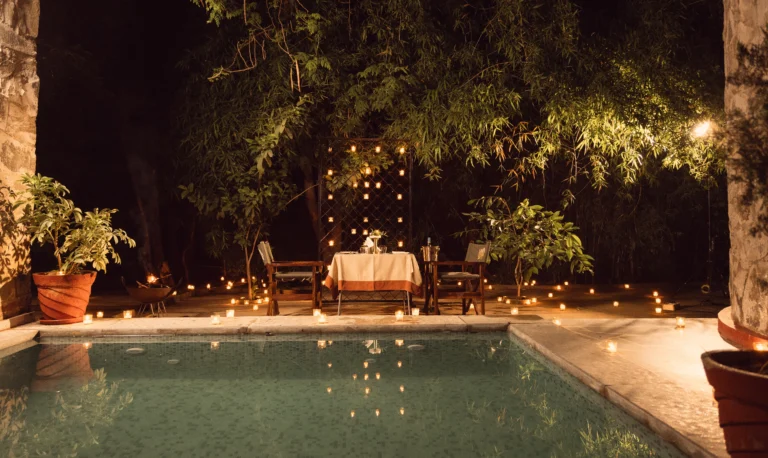
We’ve planted neem trees across our property, not as landscaping decoration, but as a genuine link to the philosophy the name represents. As they grow, they’ll do exactly what they’ve done in this region for centuries: cool the air, anchor the soil, and create natural gathering spaces for the people who pass through.
In a way, every neem tree on our grounds is a small promise that Neem Sarai isn’t just borrowing a beautiful word, but trying to live up to everything it has meant to this land for generations.
Visiting Sariska? Come experience what it means to rest the Neem Sarai way.

Welcome to Neem Sarai, where luxury meets comfort. Our commitment to providing exceptional hospitality ensures an unforgettable experience for every guest.
Copyright 2025, Kalwara Hotels Private Limited. All Rights Reserved.
Quick Link
Contact Information
- Neem Sarai Sariska, Naiduli, Tehla, Rajasthan 301410
- .+91 -9717 482225
- info@neemsaraisariska.com
